
Your roofing website design is one of the key factors that determine how many roofing contracts you win. Customers looking for roofing companies check out your website to see if they want to give you a call. If your website isn’t clean and professional, they move on to another roofing company.
A lot of roofing sites are confusing or lack crucial information, so people don’t want to waste time. People don’t want to waste time looking for information. If they can’t find the info they want, they leave without calling or filling out a contact form.
But you can change that. Improving your roofing website design can help you increase calls and leads. Here, you will find out what’s wrong with your website and how to fix it.
Is your roofing website costing you contracts every week? Get a free website audit from our team and find out exactly what's holding you back!
Key Takeaways
- A strong roofing website design helps build trust and brings more calls and leads for your business.
- Poor design, slow speed, and confusing layout can make visitors leave without contacting you.
- Simple improvements like better layout, faster speed, and clear content can boost conversions.
- A well-designed website works as a 24/7 tool to attract, engage, and convert potential customers.
Table of Contents
- Why Your Roofing Website Matters
- Signs Your Roofing Website Is Losing You Jobs
- Common Roofing Website Design Mistakes
- How Poor Design Affects Your Leads and Sales
- How to Fix Your Roofing Website (Step-by-Step)
- Must-Have Features for a High-Converting Roofing Website
- Why Choose Mandy Web Design for Your Roofing Website
- FAQs About Roofing Website Design
Why Your Roofing Website Matters
Most roofing contractors underestimate how much their roofing website design influences buying decisions. They assume word-of-mouth is enough. But the data tells a completely different story.
According to a Stanford Web Credibility Study, 75% of consumers admit to judging a company’s credibility based on their website design. That means three out of four potential customers are deciding whether to trust you — before they even read a single word about your services.
Here’s what the roofing market looks like today:
- 97% of consumers search online before hiring a local service provider (BrightLocal, 2023)
- 88% of online consumers are less likely to return to a website after a bad experience
- 53% of mobile users will abandon a website that takes longer than 3 seconds to load (Google, 2023)
- The average roofing job in the US is worth $9,000 to $12,000 — meaning every lost lead is thousands of dollars walking out the door
Your website isn’t a digital brochure. It’s your 24/7 sales rep. It needs to answer questions, build trust, and push visitors toward calling you or filling out a form.
When a storm hits your area, homeowners don’t flip through the Yellow Pages. They open Google and type “roofing company near me.” The company with the most professional, fast, and trustworthy website gets the call. Often, that call happens within 2 minutes of landing on a site.
If your website isn’t set up to win at that moment, your competitors are.
The Real Cost of a Bad Website
Let’s put real numbers behind this. Say your roofing website gets 500 visitors per month. If your conversion rate (visitors to leads) is only 1%, you’re generating 5 leads. The industry average conversion rate for a well-optimized roofing site sits between 3% and 5%.
At a 4% conversion rate, that same 500 visitors = 20 leads per month. If you close even half of those at an average job value of $10,000, that’s $100,000 in additional monthly revenue — from the same traffic, just a better website.
That’s the real website design cost of doing nothing: not what you spend, but what you silently lose.
Signs Your Roofing Website Is Losing You Jobs
How do you know if your website is underperforming? Look for these warning signs:
Your Bounce Rate Is Above 70%
Bounce rate measures how many people visit one page and leave without clicking anything else. A roofing website with a bounce rate above 70% is a red flag. It tells you visitors aren’t finding what they need and are going back to Google — straight to your competitors.
Industry benchmark: A healthy roofing website bounce rate sits between 40% and 60%.
You’re Getting Traffic But No Calls
If your Google Analytics shows traffic but your phone isn’t ringing, your site has a conversion problem. Traffic without action means the design or content isn’t compelling visitors to take the next step.
Your Website Looks Different on Mobile
Pull up your website on your phone right now. Does it look good? Is the text readable without zooming in? Can you tap the phone number easily? If the answer to any of these is no, you have a mobile responsive website problem — and it’s costing you more than you realize.
As of 2024, over 60% of all web searches are made on mobile devices. Google also uses mobile-first indexing, meaning it ranks your mobile site, not your desktop version.
Your Website Loads Slowly
Use Google’s free PageSpeed Insights tool (pagespeed.web.dev) to test your site. If your score is below 50 on mobile, you have a serious speed problem. Slow websites don’t just frustrate users — they rank lower in Google search results.
You Haven’t Updated It in Over 3 Years
Web design trends and user expectations change fast. A website built in 2020 already feels outdated to today’s visitors. If your site has small text, tiny buttons, or an old-fashioned layout, visitors mentally classify you as an outdated company — before they’ve read a word.
Common Roofing Website Design Mistakes
These are the most common design issues we see when auditing roofing websites across North America. Chances are, your site has at least two or three of these.
1. No Clear Call-to-Action Above the Fold
The “above the fold” area is everything a visitor sees before they scroll. If your phone number, a strong headline, and a clear CTA button aren’t visible immediately, you’re losing leads in the first 5 seconds.
Most roofing sites bury the contact form at the bottom of the page. Don’t make visitors hunt for how to reach you.
2. Weak or No Social Proof
Homeowners hiring a roofer are making a large financial and safety decision. They need proof that you’re trustworthy. Yet many roofing websites have zero reviews, no before-and-after photos, and no testimonials.
Websites that display customer reviews see up to 270% more conversions than those without (Spiegel Research Center).
3. Poor Web Design Layout
A cluttered web design layout confuses visitors. Too many colors, inconsistent fonts, walls of text, and random photos create cognitive overload. When visitors feel confused, they leave.
The best roofing websites use clear visual hierarchy: big, bold headline → short value statement → social proof → services → CTA.
4. Wrong Color Palettes and Typography
Many roofers choose colors that don’t communicate professionalism or trust. Dark, muddy color palettes with hard-to-read text, or bright neon colors that feel cheap, undermine your brand before a visitor reads a word.
Similarly, poor design typography — using too many fonts, fonts that are too small, or fonts that don’t render well on mobile — makes your site harder to read and less trustworthy.
Research shows that blue and dark grey color schemes tend to build the most trust in home services industries. White space (empty space) actually increases perceived quality.
5. No Local SEO Signals
Your roofing company serves specific cities and neighborhoods. If your website doesn’t mention those locations naturally throughout the content, Google doesn’t know to show your site when someone in your area searches. An SEO friendly website structure includes location-specific service pages, schema markup, and local keywords woven into your content.
6. Images That Slow Everything Down
High-quality photos of your work are essential — but most roofing websites upload images straight from a camera or phone without compression. A single unoptimized photo can be 4–8 MB, destroying your page speed. Proper image optimization means compressing photos to under 200 KB without losing visible quality, and using modern formats like WebP.
How Poor Design Affects Your Leads and Sales
Bad design isn’t just an aesthetic problem. It has a direct, measurable impact on your bottom line. Here’s how the damage spreads:
Lower Google Rankings
Google’s ranking algorithm factors in Core Web Vitals — a set of metrics measuring how fast, stable, and interactive your website is. If your site scores poorly on these metrics (which a bad design usually causes), Google pushes you down the results page. Less visibility = fewer clicks = fewer leads.
Higher Cost-Per-Lead on Paid Ads
If you’re running Google Ads or Facebook Ads for your roofing business, your landing page quality directly affects your ad costs. Google’s Quality Score penalizes ads that send traffic to poor-quality pages. You end up paying more per click for the same results — or worse results.
Benchmark: Roofing companies with optimized landing pages report a Cost-Per-Lead 40–60% lower than those sending ad traffic to generic homepages.
Losing to Competitors on First Impression
A 2023 survey by Top Design Firms found that 38% of users will stop engaging with a website if the content or layout is unattractive. In a competitive local market, being second-best in design often means being last in leads.
Damaged Brand Trust
The elements of good website design — consistency, clarity, speed, and professionalism — signal to visitors that you run a legitimate, organized business. Poor design signals the opposite: that you cut corners. If visitors think you cut corners on your website, they’ll wonder if you cut corners on their roof.
Don't let a broken website drain your marketing budget. Our team specializes in roofing websites that convert visitors into paying customers.
How to Fix Your Roofing Website (Step-by-Step)
Now let’s talk about solutions. Here’s a practical, prioritized roadmap to turn your roofing website into a lead-generating machine.
Step 1: Audit Your Current Website
Before you fix anything, you need to know exactly what’s broken. Run your site through these free tools:
- Google PageSpeed Insights — measures load speed and Core Web Vitals
- Google Search Console — shows your search visibility and indexing issues
- Screaming Frog (free version) — crawls your site for broken links and SEO problems
- GTmetrix — gives a detailed breakdown of what’s slowing your site down
This audit forms the foundation of your website design process. Skipping it means guessing — and guessing wastes money.
Step 2: Fix Your Website Speed
Website speed optimization is the single highest-ROI fix for most roofing websites. Start with:
- Compress all images using tools like TinyPNG or ShortPixel (aim for under 200 KB per image)
- Enable browser caching so returning visitors load pages faster
- Use a Content Delivery Network (CDN) like Cloudflare (free plan available)
- Minimize CSS and JavaScript files — your developer can do this with a few clicks
- Upgrade your hosting if you’re on cheap shared hosting; move to managed WordPress hosting
A one-second improvement in page load time can increase conversions by 7% (Akamai). For a roofing site generating $50,000/month in revenue, that’s $3,500/month more — from one fix.
Step 3: Redesign for Mobile First
Since Google uses mobile-first indexing, your site needs to be designed for phones before desktops. A true mobile responsive website isn’t just “shrinks on mobile” — it’s one where:
- Text is readable without zooming (minimum 16px font size)
- Buttons are large enough to tap with a thumb (minimum 44px height)
- Your phone number is a clickable tap-to-call link
- Forms are short and easy to fill out on a touchscreen
- The navigation menu works cleanly on small screens
Test your site using Google’s Mobile-Friendly Test tool (search.google.com/test/mobile-friendly).
Step 4: Redesign Your Homepage Layout
Your homepage needs to do one job: get visitors to contact you. Structure it like this:
Section 1 — Hero (Above the Fold)
- Strong, specific headline (“Expert Roof Repair & Replacement in [City Name]”)
- Subheadline with your key differentiator (“Licensed, insured, and trusted by 500+ homeowners”)
- Phone number in large text
- “Get a Free Estimate” button in a contrasting color
- High-quality photo of your team or a completed job
Section 2 — Trust Signals
- Star rating + number of Google Reviews
- Years in business
- Licenses and certifications (GAF Master Elite, Owens Corning Preferred, etc.)
- Insurance logos
Section 3 — Services Overview
- Brief cards for each major service (Roof Repair, Roof Replacement, Storm Damage, etc.)
- Each card links to a dedicated service page
Section 4 — Why Choose Us
- 3–4 differentiators with icons (Fast Response, Lifetime Warranty, Free Inspection, etc.)
Section 5 — Reviews / Testimonials
- At least 5 real customer reviews with full names and star ratings
- Embed your Google Reviews widget if possible
Section 6 — Service Areas
- List all cities and towns you serve (helps with local SEO)
Section 7 — Final CTA
- Another “Get a Free Estimate” form or phone number
Step 5: Improve Website UX Throughout
Improving website UX means making every part of your site easy, intuitive, and frustration-free. Practical UX improvements for roofing sites:
- Sticky header — phone number and CTA button stay visible as users scroll
- Consistent navigation — no more than 6–7 items in your menu
- Clear page hierarchy — use H1, H2, H3 headings logically (helps both readers and Google)
- Short paragraphs — 2–3 sentences max per paragraph
- White space — don’t crowd elements; space makes sites feel premium
- Accessible color contrast — text must be readable for all users, including those with visual impairments
Step 6: Build an SEO-Friendly Website Structure
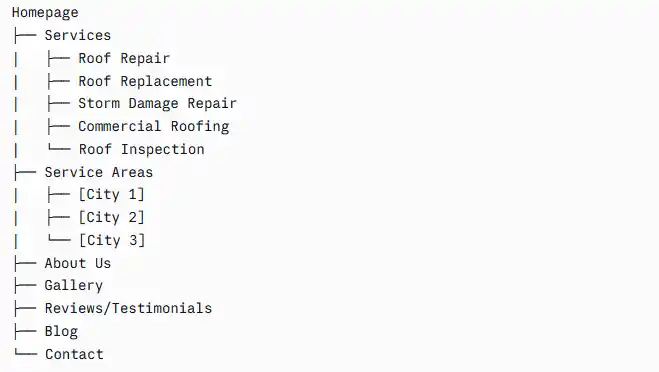
Your website’s architecture determines how Google crawls and ranks your pages. For roofing companies, the ideal SEO friendly website structure looks like this:
Each service page and city page should be fully fleshed out — not just a paragraph. Google rewards depth. Pages with 1,000+ words of relevant content consistently outrank thin pages in local service searches.
Step 7: Add Real Proof and Build Trust Signals
Trust is the currency of roofing websites. Your EEAT signals (Experience, Expertise, Authoritativeness, Trustworthiness) must be visible throughout:
- Before-and-after photo galleries — real jobs you’ve completed
- Video testimonials — even a 30-second phone video from a happy customer is powerful
- Team photos — show real faces, not stock photos
- Certifications and manufacturer badges — prominently display these
- BBB rating, Angi badge, or HomeAdvisor credentials
- Named case studies — “We replaced a 40-square roof for the Johnson family in Tampa after Hurricane Ian damage. Here’s the story.”
According to BrightLocal’s 2024 Local Consumer Review Survey, 87% of consumers read online reviews for local businesses, and 79% trust online reviews as much as personal recommendations.
Must-Have Features for a High-Converting Roofing Website
Beyond fixing what’s broken, here are the non-negotiable features that top-performing roofing websites share:
1. Instant Quote Request Form
Keep it short: Name, Phone, Email, Service Type, Brief Description. Long forms kill conversions. Forms with 3–5 fields convert at 2x the rate of forms with more than 6 fields (HubSpot data).
Place this form on your homepage, service pages, and contact page.
2. Live Chat or Chat Widget
Many potential customers don’t want to call — they want to ask a quick question first. A live chat widget (or even an AI chatbot) can capture these visitors. Studies show live chat can increase conversions by up to 45% on service business websites.
3. Click-to-Call Phone Number
Every page. Every header. On mobile, every phone number should be a tap-to-call link (using tel: links). Don’t make people copy-paste your number.
4. Google Reviews Integration
Embed a live Google Reviews feed so visitors see real, recent reviews without leaving your site. This is one of the most powerful trust signals you can add.
5. Service Area Pages
Dedicated pages for each city you serve. Each page should mention the city name naturally throughout the content, include a local map embed, and reference specific neighborhoods or landmarks. This is how roofing companies show up in “[city] roofing company” searches.
6. SSL Certificate (HTTPS)
If your website URL starts with http:// instead of https://, you have a security problem. Google marks non-HTTPS sites as “Not Secure,” which instantly destroys trust. SSL certificates are free through most hosting providers. Fix this immediately.
7. A Blog That Answers Real Questions
A regularly updated blog builds topical authority — it tells Google you’re an expert in roofing. It also brings in organic traffic from homeowners searching questions like “how long does a roof last,” “signs I need a new roof,” or “how much does a roof replacement cost.”
Blog posts that target these questions generate warm leads — people already in research mode who are close to hiring someone.
8. Regular Website Health Monitoring
Your website isn’t a “set it and forget it” asset. Website health monitoring means checking monthly for:
- Broken links (404 errors)
- Slow-loading pages
- Google Search Console errors
- Outdated content (prices, service areas, contact info)
- Security vulnerabilities
Tools like SEMrush, Ahrefs, or even free options like Google Search Console make this manageable.
9. Work With the Right Professionals
If DIY website builders aren’t cutting it — and for most roofing companies generating serious revenue, they’re not — it’s worth investing in professional help. The top web design companies that specialize in contractor and home services websites understand both design and lead generation. They don’t just make sites look good; they build sites that rank and convert.
When evaluating agencies, ask specifically about their experience with home services businesses, their approach to local SEO, and whether they can show you conversion rate data from existing roofing clients.
Why Choose Mandy Web Design for Your Roofing Website
Mandy Web design is a leading website design agency that understands what roofing businesses need to grow online. We don’t just create websites—we build lead-generating platforms that help you get more calls and bookings. Our focus is on simple, clean, and high-converting designs that turn visitors into real customers.
Our services include custom design, WordPress design, UI/UX design, responsive design, landing page design, and website redesign. We make sure your site is easy to use, mobile-friendly, and built to match your business goals.
We also focused on results. We help improve your website’s performance, user experience, and visibility so you can stay ahead of competitors. Whether you need a new website or want to upgrade your existing one, hire web designers from our team to help your roofing business grow.
Want more calls and roofing leads from your website? Let’s improve your design and turn visitors into real customers!
FAQs About Roofing Website Design
Your roofing website may not be getting leads because it is slow, outdated, or hard to use. If visitors cannot find information quickly or don’t trust your design, they leave. A clear layout, fast speed, and strong call-to-action can improve your results.
Roofing website design directly impacts how customers see your business. A professional and clean website builds trust and encourages people to contact you. A poor design creates doubt and pushes potential customers toward your competitors, reducing your chances of getting jobs.
A good roofing website should have clear service pages, easy contact options, customer reviews, and fast loading speed. It should also work well on mobile devices and guide users to take action. These features help improve user experience and increase leads
You can improve your roofing website by updating the design, improving speed, and making navigation simple. Add clear calls-to-action and ensure your contact details are easy to find. Even small improvements can make a big difference in user experience and lead generation.
Most people search for roofing services on their phones. If your website is not mobile-friendly, users will find it hard to use and leave quickly. A mobile-friendly design ensures your site looks good and works smoothly on all devices, helping you get more leads.
Website speed is very important because users don’t like waiting. If your website takes too long to load, visitors leave before seeing your services. A faster website keeps users engaged, improves their experience, and increases the chances of them contacting you.
Yes, investing in a professional roofing website design is important for long-term growth. A well-designed website helps build trust, attract more visitors, and convert them into customers. It works as a powerful marketing tool that brings consistent leads to your business.
Mandy Web Design focuses on creating simple, modern, and high-converting roofing websites. We understand your business needs and build websites that attract visitors and turn them into leads. With reliable support and affordable solutions, we help you grow your roofing business online.

About the Writer
Abhishek Thakur
Sr. Content Writer at Mandy Web Design
Abhishek Thakur is the Senior Content Writer at Mandy Web Design, where he crafts engaging content for the company’s website, blog, and marketing campaigns. With 5+ years of experience in digital marketing and SEO content creation, he specializes in turning complex topics into easy-to-understand, actionable strategies that help businesses grow online. He is passionate about creating high-quality, value-driven content that connects with audiences and builds brand authority. When he’s not writing, he enjoys exploring new ideas, learning the latest marketing trends, and improving his creative skills.