
Objective;
The objective of this blog is to help readers understand the key differences between static and dynamic websites, focusing on speed, security, and performance, so they can choose the best option for their needs.
Website architecture plays a crucial role in determining how fast, secure, and scalable a site can be. At the core of this architecture lies a fundamental choice between static and dynamic websites—two approaches that differ in how content is created, delivered, and maintained.
Did You Know? Static websites can load up to 10x faster than dynamic websites because they don’t rely on real-time server processing or database queries, making them one of the most efficient options for speed and security
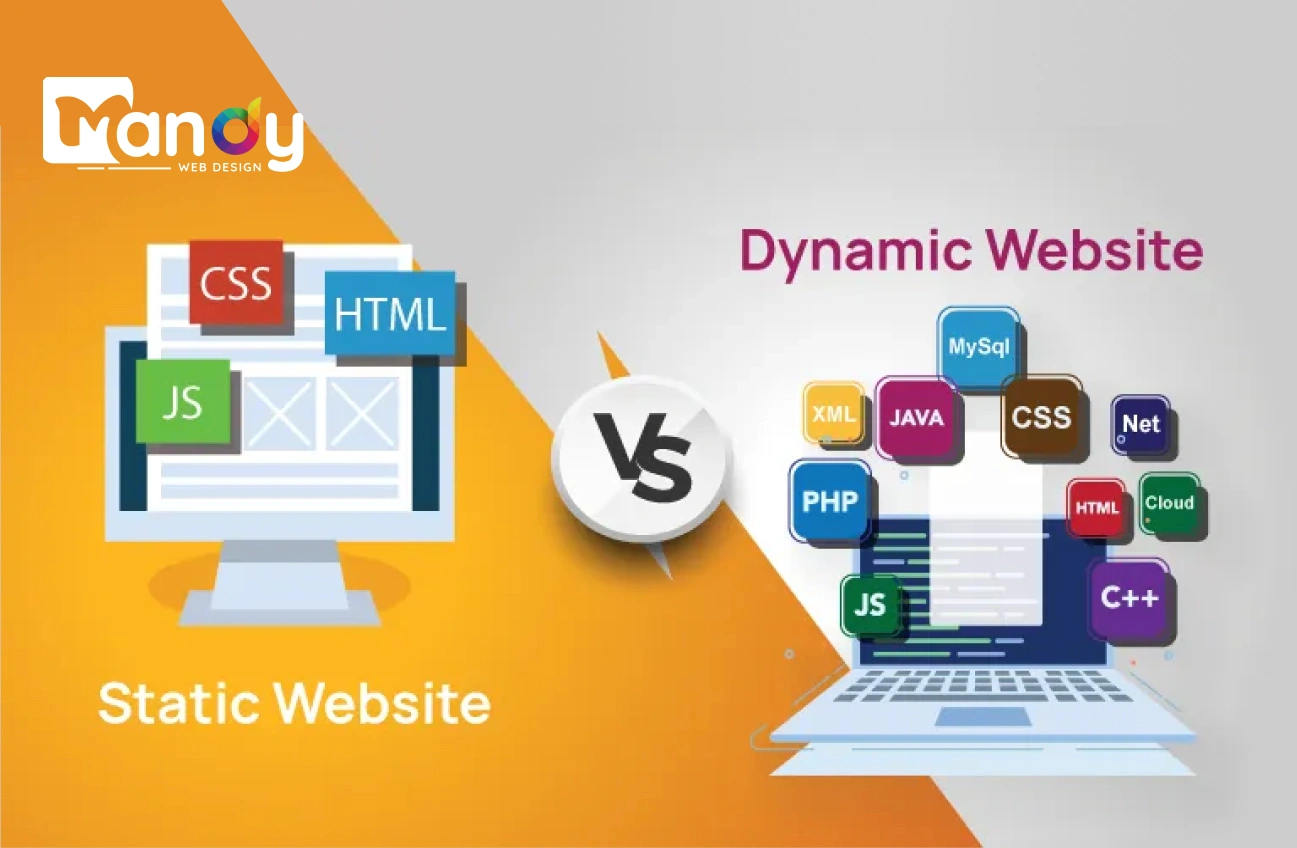
Static websites are built using fixed files that are served directly to users, making them fast, reliable, and less prone to security vulnerabilities. In contrast, dynamic websites generate content in real time using servers and databases, enabling interactive features and personalized experiences but often adding complexity.
Understanding the differences between these two approaches is essential when building a website. In this blog, we’ll compare static and dynamic websites in terms of speed and security, helping you decide which option best suits your needs.
Build a Lightning-Fast, Secure Website Today – Choose Between Static or Dynamic with Mandy Web Design, Starting at Just $10/Hour!
Key Takeaways
- Static sites load faster and have fewer vulnerabilities.
- Dynamic sites allow personalization and real-time updates.
- Static sites are cheaper and easier to maintain; dynamic sites require more resources.
- Jamstack and headless CMS combine speed, security, and interactivity.
Table of Contents
- What Is a Static Website?
- What Is a Dynamic Website?
- Key Differences Between Static and Dynamic Websites
- Which Is Faster?
- Which Is More Secure?
- Pros and Cons of Static Websites
- Pros and Cons of Dynamic Websites
- When to Choose Static vs Dynamic
- Cost and Maintenance Comparison
- Future Trends in Web Development
- Why Choose Mandy Web Design for Static & Dynamic Website Development
- FAQs About Static and Dynamic Websites
What Is a Static Website?
A static website consists of pre-built HTML, CSS, and JavaScript files that are stored on a server and delivered exactly as-is to every visitor. There is no server-side processing involved—the files are ready to go the moment a user requests them.
When a user types a URL into their browser, the web server immediately returns the pre-compiled files without executing any code or querying a database. This simplicity is what makes static sites extremely fast and reliable.
Common examples of static websites include portfolio websites, landing pages, personal blogs, documentation sites, and marketing pages.
Modern static sites are often built using static site generators (SSGs) such as Gatsby, Hugo, Jekyll, or Next.js in static mode. These tools allow developers to use templates and dynamic data during the build process—but the final output is always flat, pre-rendered HTML files. This approach is a cornerstone of modern web development trends, combining speed with simplicity.
What Is a Dynamic Website?
A dynamic website generates content in real time on the server before delivering it to the user. Each request triggers a chain of processes: the server runs back-end code, queries a database, assembles HTML on the fly, and then sends the result to the browser.
This on-demand content generation allows dynamic websites to display personalized information, handle user accounts, process transactions, and update content without requiring a developer to manually edit files.
Examples of dynamic websites include e-commerce platforms (like Amazon or Shopify stores), social media networks, online banking systems, news portals, and SaaS dashboards.
Dynamic sites are typically built with server-side languages such as PHP, Python (Django/Flask), Ruby on Rails, or Node.js, paired with databases like MySQL, PostgreSQL, or MongoDB. While the website development process for dynamic sites is more involved, they offer unparalleled flexibility and interactivity.
Key Differences Between Static and Dynamic Websites
Feature | Static Website | Dynamic Website |
Page Loading Speed | Extremely fast | Moderate to slow |
Server Processing | None (pre-built files) | Required (server-side) |
Database Usage | Not needed | Required |
Security Risk | Very low | Higher (more attack surfaces) |
Personalization | Limited | Full real-time personalization |
Scalability | High (CDN-friendly) | Requires infrastructure scaling |
Web Development Cost | Lower | Higher |
Maintenance Effort | Minimal | Ongoing |
SEO Friendly Website Structure | Excellent | Good (with optimization) |
Best For | Blogs, portfolios, landing pages | E-commerce, SaaS, social platforms |
Which Is Faster?
Speed is where static websites have an undeniable and significant advantage. Let’s break down why.
Why Static Websites Are Faster
No Server-Side Processing: Static files are served immediately—there is no back-end code to execute, no database queries to run, and no assembly of HTML on the fly.
CDN Compatibility: Static files are perfectly suited for Content Delivery Networks (CDNs). A CDN stores copies of your site at data centers around the world, serving content from the location closest to the user and dramatically reducing latency.
Smaller File Footprint: Static sites typically have fewer dependencies and lighter payloads, which contributes to faster Time to First Byte (TTFB) and quicker overall page loads.
Simplified Website Speed Optimization: Since there are no database calls or server-side rendering bottlenecks, website speed optimization for static sites is more straightforward—focusing mainly on image optimization, minifying CSS/JS, and leveraging browser caching.
Why Dynamic Websites Are Slower
Server Processing Time: Every user request triggers code execution on the server. Complex applications with many database calls can add hundreds of milliseconds of delay.
Database Query Latency: Retrieving data from a database, especially under heavy traffic, introduces additional wait time before a page can even begin rendering.
Rendering Overhead: Server-side rendering requires the server to assemble the complete HTML document before sending it to the browser, adding to overall load time.
Bridging the Gap
That said, dynamic websites can close the speed gap significantly with proper techniques such as caching (Varnish, Redis), database query optimization, and the use of modern frameworks with built-in performance features. However, even a heavily optimized dynamic site rarely matches the raw speed of a well-built static site. For teams focused on UI UX trends and delivering the fastest possible user experience, this distinction matters enormously.
Build a Lightning-Fast, Secure Website Today
Whether you need a static, dynamic, or hybrid website, Mandy Web Design delivers high-performance, secure, and mobile responsive websites tailored to your business goals.
Which Is More Secure?
Security is another area where static websites enjoy a structural advantage—but the story is more nuanced when you factor in how websites are built and maintained.
Why Static Websites Are More Secure
No Server-Side Attack Surface: Since static websites have no back-end code or database, they are immune to some of the most common web vulnerabilities—SQL injection, remote code execution, and server-side request forgery simply do not apply.
No Database to Breach: Without a database, there is no repository of sensitive user data that can be stolen through an injection attack or misconfigured access controls.
Fewer Dependencies: Static sites typically have fewer third-party integrations and plugins, each of which represents a potential security vulnerability.
Simpler Hosting Environment: Hosting a static site on a CDN or object storage service (like AWS S3 or Cloudflare Pages) removes many attack vectors associated with traditional web servers running PHP or other interpreted languages.
Dynamic Website Security Challenges
SQL Injection: If user inputs are not properly sanitized, attackers can manipulate database queries to access, modify, or delete data.
Cross-Site Scripting (XSS): Dynamic websites that render user-generated content without proper escaping are vulnerable to XSS attacks.
Authentication Vulnerabilities: Session management, password storage, and access controls must all be implemented correctly—each represents a potential weak point.
Plugin and Dependency Risks: CMS platforms like WordPress rely on plugins, many of which have known vulnerabilities that attackers actively exploit.
Can Dynamic Websites Be Secured?
Absolutely. With proper security practices—regular updates, input validation, HTTPS, strong authentication, and regular security audits—dynamic websites can be made highly secure. However, achieving that security level requires consistent effort and expertise. Static websites achieve a strong security baseline almost by default.
Pros and Cons of Static Websites
Pros
- Blazing-fast load times with minimal latency
- Excellent SEO friendly website structure — clean URLs, fast TTFB, and no duplicate content issues
- Very low hosting costs — can often be hosted for free on platforms like Netlify, Vercel, or GitHub Pages
- Minimal security vulnerabilities due to the absence of server-side code and databases
- Easy to scale — CDN distribution handles massive traffic spikes without additional configuration
- Simple deployment — updating a static site can be as easy as pushing code to a Git repository
- Great for design typography and layout experimentation since the front-end is fully decoupled
Cons
- Limited interactivity without third-party APIs or JavaScript frameworks
- Not suitable for user authentication, personalized dashboards, or real-time content
- Build times can increase significantly for very large sites with thousands of pages
- Content updates require a rebuild and redeployment (though modern CI/CD pipelines automate this)
- Developers need familiarity with static site generators and modern tooling
Pros and Cons of Dynamic Websites
Pros
- Full support for user accounts, personalization, and real-time content updates
- Ideal for complex applications: e-commerce, social networks, SaaS platforms
- Content can be managed through a CMS without developer involvement
- Easily integrates with databases, payment processors, and third-party APIs
- Supports advanced features like A/B testing, targeted recommendations, and dynamic pricing
- Flexible web design layout options driven by real-time data
Cons
- Slower load times without significant optimization effort
- Higher web development cost due to complex back-end architecture and ongoing maintenance
- Greater security exposure — more attack surfaces require more vigilance
- Higher hosting costs — requires dedicated servers or cloud compute instances
- More complex website development process involving servers, databases, and deployment pipelines
- Performance and security degrade over time if not actively maintained
When to Choose Static vs Dynamic
Choose a Static Website When:
- Your site’s content is relatively stable and doesn’t need real-time personalization
- Speed and security are top priorities — such as for landing pages, portfolios, or documentation
- You want a low web design cost with minimal ongoing infrastructure expenses
- You’re building a blog, marketing site, or informational resource
- Your development team wants a straightforward workflow with version-controlled content
- ou need an SEO-optimized, mobile responsive website that loads instantly on desktop and mobile
Choose a Dynamic Website When:
- You need user authentication, personalized dashboards, or account management
- Your site sells products, processes payments, or manages orders (e-commerce)
- Content changes frequently and needs to be managed by non-technical team members via a CMS
- You’re building a social platform, community forum, or collaborative tool
- Your application requires real-time features like live chat, notifications, or dynamic pricing
- You need a complex, data-driven application that cannot function without server-side logic
Pro Tip: Many modern teams choose a “hybrid” or “Jamstack” approach — a static front-end powered by dynamic APIs for specific features like search, authentication, and checkout. This gives you the speed and security of static delivery with the functionality of dynamic systems.
Cost and Maintenance Comparison
Cost is a practical factor that often determines architectural choices. Here’s how static and dynamic websites compare from a financial and operational standpoint.
Web Development Cost
Static websites are generally less expensive to build. Since there is no back-end infrastructure to design and implement, development time is shorter and the skill set required is less specialized. A well-built static site can be created by a front-end developer alone, whereas dynamic sites typically require both front-end and back-end expertise.
Dynamic websites involve more complex architecture: database design, API development, server configuration, and security hardening all add to the initial web development cost. Depending on the complexity of the application, dynamic web projects can cost two to five times more than their static equivalents.
Hosting Costs
Static websites can be hosted for free or at minimal cost on platforms like Netlify, Vercel, GitHub Pages, or Cloudflare Pages. Even high-traffic static sites cost very little because the files are served from CDN edge nodes rather than compute-intensive servers.
Dynamic websites require server infrastructure — VPS instances, managed cloud services, or container orchestration platforms like Kubernetes. These costs grow with traffic and can become substantial for high-volume applications. Database hosting, caching layers, and load balancers further add to monthly expenses.
Maintenance Overhead
Static websites require minimal ongoing maintenance. There are no server patches to apply, no database to optimize, and no plugin updates to manage. Security updates are generally handled at the hosting platform level.
Dynamic websites require active, ongoing maintenance. Server software must be kept updated, database performance needs regular monitoring, and dependencies (frameworks, libraries, plugins) must be patched promptly to address security vulnerabilities. This ongoing maintenance overhead should be factored into the total cost of ownership when evaluating web design cost.
Cost Snapshot: A basic static website can be hosted for as little as $0–$20/month, while a dynamic web application with similar traffic might cost $50–$500+ per month depending on server specs, database requirements, and additional services.
Future Trends in Web Development
The web development landscape is evolving rapidly, and the line between static and dynamic websites is becoming increasingly blurred. Here are the key trends shaping the future of both approaches.
The Rise of the Jamstack
Jamstack architecture — JavaScript, APIs, and Markup — represents the convergence of static and dynamic paradigms. In the Jamstack model, the front-end is pre-rendered and served statically, while dynamic functionality is delivered through APIs and serverless functions. This approach is one of the defining web development trends of the current era, enabling teams to ship fast, secure sites without sacrificing interactivity.
Edge Computing and Serverless Functions
Edge computing is pushing computation closer to the user, reducing latency for dynamic operations. Serverless platforms like Cloudflare Workers, AWS Lambda@Edge, and Vercel Edge Functions allow developers to run dynamic logic at CDN edge nodes — giving dynamic-like functionality with near-static speeds. This development is reshaping how teams think about performance and infrastructure.
Headless CMS Adoption
Headless content management systems — such as Contentful, Sanity, or Storyblok — are enabling teams to combine the editorial flexibility of dynamic content management with the performance benefits of static delivery. Content is managed through an API and injected at build time or via client-side calls, decoupling content from presentation.
AI-Driven Design and Personalization
Advances in AI are beginning to bridge the personalization gap for static sites. AI-powered tools can generate personalized content variants at build time, while edge-based personalization engines deliver customized experiences without heavy server-side processing. As UI UX trends increasingly prioritize personalization, expect to see static and AI-driven tools working in tandem.
Performance-First Design
Core Web Vitals — Google’s framework for measuring user experience — have made website speed optimization a non-negotiable SEO priority. Modern design systems emphasize performance at every layer: efficient color palettes that minimize paint operations, design typography choices that reduce layout shifts, image optimization through next-gen formats like WebP and AVIF, and streamlined web design layout patterns that minimize render-blocking resources.
Sustainability in Web Development
Green web development is an emerging area of focus. Static websites, by virtue of their lower computational requirements and CDN-based delivery, have a smaller carbon footprint than equivalent dynamic sites. As sustainability becomes a factor in technology decisions, the efficiency of static delivery may gain additional appeal.
Why Choose Mandy Web Design for Static & Dynamic Website Development
Mandy Web Design doesn’t just build websites—we create high-performance digital experiences tailored to your business goals. Whether you need a lightning-fast static website or a powerful dynamic platform, our team ensures the perfect balance of speed, security, and scalability.
We are a leading web design and development agency that specialize in both static and dynamic website development, helping businesses choose the right architecture based on their needs. From simple landing pages to complex web applications, we design solutions that are optimized for performance and growth.
We prioritize website security at every stage of development while offering a complete range of web design and development services to support your business growth. Our web design services include Custom Design, WordPress Design, UI/UX Design, Responsive Design, Website Redesign, Landing Page Design. Alongside this, our web development services cover Custom Development, WordPress Development, PHP Development, Node.js Development, Backend Development, Full Stack Development, Website Migration, and Website Maintenance, ensuring your website is fast, secure, scalable, and future-ready.
Ready to build a fast, secure, and scalable website? Partner with Mandy Web Design and choose the right solution—static or dynamic—for your business success.
Want a Website That Loads Instantly and Protects Your Data?
Partner with Mandy Web Design to create fast, secure websites optimized for speed, SEO, and user experience across all devices.
FAQs About Static and Dynamic Websites
Static websites deliver fixed content to all users, while dynamic websites generate content on the fly using server-side logic and databases, allowing interactivity, personalization, and frequent updates.
Yes. Static websites load faster because files are pre-built and served immediately, without server-side processing or database queries, reducing latency and improving overall page speed.
Static websites are generally more secure, as they lack backend code and databases. Dynamic websites have multiple attack surfaces, including user input handling, authentication, and plugins, requiring consistent security management.
Dynamic websites can be optimized using caching, CDNs, and database query improvements, but even with optimization, they rarely reach the raw loading speed of well-built static websites.
Static sites are ideal for portfolios, landing pages, blogs, documentation, and marketing websites where content rarely changes, and speed, reliability, and low maintenance are top priorities.
Dynamic websites are best for e-commerce, SaaS platforms, social networks, or sites requiring user accounts, personalized dashboards, real-time updates, or frequent content changes managed through a CMS.
Yes. A hybrid approach, like Jamstack, uses static front-ends for speed while integrating dynamic APIs for interactivity, combining performance, security, and functionality effectively.
Check for interactivity: login systems, user dashboards, and live updates usually indicate dynamic websites, whereas static sites deliver the same pre-built content to every visitor without server-side changes.

About the Writer
Mandeep Singh Chahal
Founder/CEO, Mandy Web Design
Mandeep Singh Chahal is the Founder/ CEO of Mandy Web Design, a top-rated web design and development agency in India. With over 22 years of experience in digital marketing, he has helped businesses across various industries establish and strengthen their online presence through strategic design and SEO implementation. He focuses on creating digital solutions that address real business challenges and drive measurable growth. His approach combines deep industry knowledge with practical execution in web design, development, and search engine optimization, enabling him to transform business objectives into effective digital strategies that deliver results.